Service Models 10 min read
When Should You Hire a Short-Let Property Manager?
Self-managing a UK holiday let requires twenty to forty hours of work each week. Property owners should hire professional support when travel distance exceeds thirty minutes, administrative tasks consume over ten hours monthly, or portfolio growth makes manual coordination impossible. Professional management protects rental yields and ensures compliance with complex safety regulations.
Hannah Clarke
Guest Experience Contributor
Writes about guest communications, smooth stays, and practical ways hosts can improve the guest experience.

Managing a UK holiday let quickly consumes twenty or more hours every single week, turning a passive property investment into an exhausting second job. Successful delegation depends on cold operational numbers like driving distance, guest messaging volume, and statutory safety deadlines rather than mere convenience. Examining these specific operational triggers shows you the exact moment professional management protects your profit margin and your sanity.
When to Hire Airbnb Property Manager
Knowing when to hire Airbnb property manager support depends heavily on the physical distance between your primary home and the rental property. Hosts who live more than thirty minutes away face major travel delays during mid-week turnovers, check-in lockouts, and sudden plumbing failures. Smart owners assess travel time realistically before deciding on airbnb management strategy because long travel distances quickly erode booking profitability and damage review scores.
On-site presence directly dictates guest review outcomes across competitive UK tourism hotspots. Rapid physical intervention prevents minor maintenance hiccups from escalating into expensive guest refund requests or platform cancellations. Professional teams maintain field staff within specific catchment zones, allowing them to resolve urgent on-site repairs far faster than a remote owner can manage.
Emergency response capacity requires immediate access to licensed tradespeople and physical keys. Remote owners frequently struggle to find emergency plumbers on bank holidays or late Sunday evenings. An unresolved leak or heating failure forces platforms to rehouse guests, costing landlords hundreds of pounds in lost booking revenue and penalty fees.
Assessing Time Cost and Occupancy Returns
Self-managing hosts dedicate between thirty and forty hours per month to run a single full-time holiday let listing successfully.[1] Owners spend this considerable time balancing guest communications, scheduling cleaners, ordering replacement supplies, and updating manual pricing calendars. High administrative burdens quickly exhaust landlords who balance hosting alongside full-time careers or family commitments.
Automation tools save time, but hosts must still spend at least ten hours each month handling non-automatable manual tasks.[1] Physical inspections, linen replenishment, and deep maintenance checks demand ongoing personal labour regardless of digital software. Calculating your personal hourly rate against these recurring hours clarifies whether self-management remains financially rational.
Revenue performance also depends on continuous rate adjustments across changing market conditions. Individual hosts often keep static prices and lose bookings during quiet shoulder months or undercharge during local peak events. Dedicated management agencies deploy algorithmic dynamic pricing software, offsetting commission costs by increasing gross booking revenues across the entire calendar.
Self-Management Versus Professional Agency Operations
| Operational Area | Self-Management Host | Professional Manager | Primary Impact |
|---|---|---|---|
| Guest Communication | Host replies personally | Dedicated 24/7 team | Faster response times |
| Turnover Logistics | Direct cleaner oversight | Contracted commercial teams | Consistent cleaning quality |
| Maintenance Handling | Host finds tradespeople | Vetted on-call contractors | Lower emergency costs |
| Pricing Strategy | Manual calendar updates | Algorithmic daily adjustments | Higher annual revenue |
| Legal Compliance | Owner monitors laws | Standard compliance audits | Reduced legal liabilities |
| Platform Distribution | Single platform listing | Multi-channel syncing | Broader market reach |
Evaluating Outsource Airbnb Management Fees
Deciding whether to outsource Airbnb management requires a clear comparison between agency commission fees and the tangible revenue gains professional teams deliver. Most UK management agencies charge fees ranging between 20% and 30% of gross booking revenue.[2] Owners who examine full property management responsibilities discover that this fee covers listing creation, multi-channel marketing, round-the-clock guest relations, and complete maintenance coordination.
Lower bound: 20; Upper bound: 30 percent represents the typical commission spread across British agencies depending on location and service level. While losing a quarter of gross income seems substantial, professional operators routinely boost net takings through multi-platform distribution and optimized pricing algorithms. Hosts who spend twenty hours weekly running operations discover that professional delegation recovers valuable personal time while protecting net rental income.
UK Property Management Fee Ranges

Meeting Round-the-Clock Guest Expectations
Beyond the logistical challenges of maintenance and distance, the human element of guest communication remains a critical factor in property success.
Modern holidaymakers expect instant replies to messages at any hour of the day or night. Individual landlords who attempt to self manage holiday let properties struggle to maintain fast response times while working office hours or sleeping. Establishing formal contracts like drafting uk cohosting contracts or delegating to an agency ensures guests receive professional assistance within minutes, which protects listing ratings on major platforms.
Handling midnight lockouts and sudden boiler breakdowns requires uninterrupted operational readiness. An exhausted host who misses an emergency message risks severe guest complaints, negative online reviews, and forced cancellation penalties from platforms. Professional management companies operate dedicated customer support desks that field calls and dispatch local contractors immediately, preserving positive guest relationships and host reputations.
Scaling Beyond a Single Unit
As your portfolio grows, the administrative burden shifts from simple maintenance to complex, multi-unit coordination.
Operational complexity multiplies rapidly once an investor acquires a second or third holiday rental unit. Managing two listings requires coordinating multiple turnover teams, tracking different linen inventories, and resolving overlapping maintenance emergencies simultaneously. Landlords who attempt to self-manage multi-property portfolios without administrative support experience acute operational bottlenecks, leading to cleaner scheduling mix-ups and missed guest messages.
Multi-calendar management demands centralized systems and rigorous logistical oversight to avoid double bookings across independent platforms. Full-time listings require twenty or more hours of weekly attention per property, making unassisted expansion impractical for independent owners.[2] Partnering with an established management agency enables landlords to scale portfolio size smoothly without sacrificing personal time or accommodation standards.
Navigating Safety Rules and Regulations
Beyond operational logistics, the legal landscape for short-term rentals requires constant vigilance and professional oversight.
Carefully evaluating whether a short let manager worth it becomes obvious when confronting the complex web of UK statutory safety legislation. Property owners must comply with the Furniture and Furnishings Regulations 1988, complete annual gas safety checks, and organize portable appliance testing for guest equipment. Owners must also manage vacation rental tax obligations while tracking local planning laws, mandatory licensing schemes in Scotland, and upcoming registration requirements in England.
Regional regulations impose severe financial and criminal penalties on non-compliant short-let accommodation providers. Scottish local authorities fine operators up to £2,500 for providing false or misleading licensing details, while English councils strictly enforce 90-night caps in Greater London. Professional management firms protect landlords by maintaining strict audit trails for mandatory legionella risk assessments, five-year electrical installation condition reports, and local council requirements.
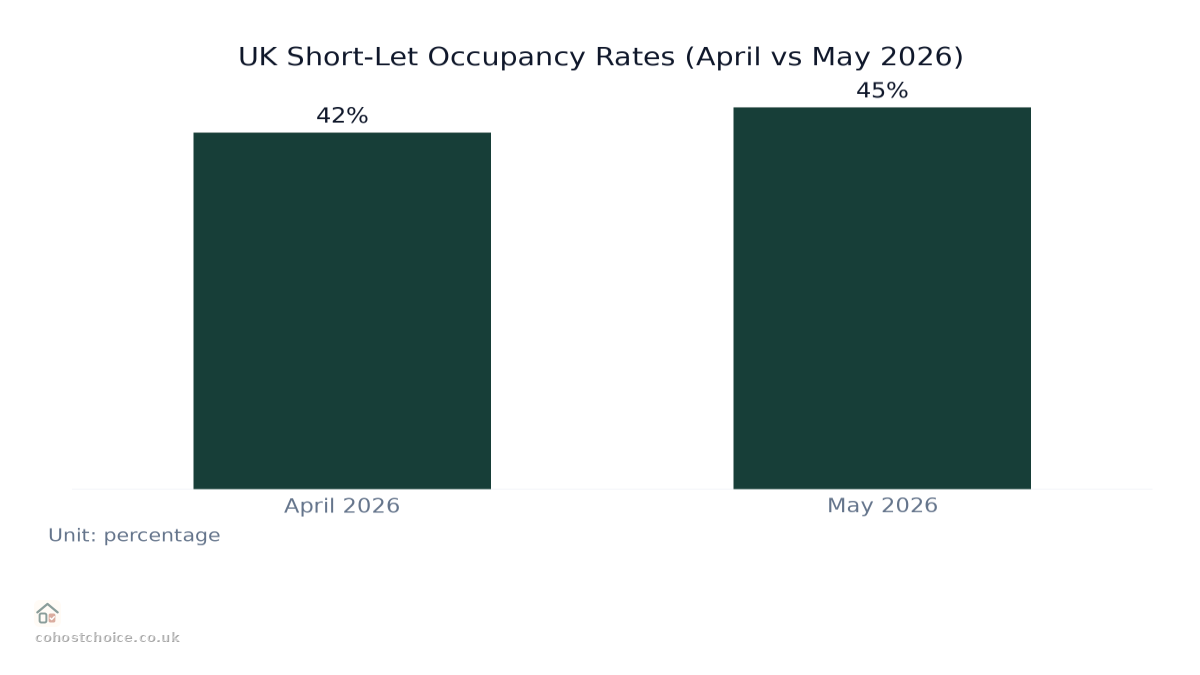
UK Short-Let Occupancy Rates (April vs May 2026)
Finding Reliable Professional Management
Once you have determined that professional support is required, the next step involves identifying a partner who can deliver consistent results.
Selecting the right operational partner requires comparing local service coverage, contract terms, and fee structures across genuine companies. UK short-let occupancy rates were 42% in April 2026 and 45% in May 2026, demonstrating steady market demand that requires active management to capture. Property owners can use the CoHostChoice directory to compare like with like across verified local and national operators in a consistent format based on published information.
Landlords gain commercial peace of mind by researching verified providers before signing long-term operational agreements. The directory enables owners to review transparent service tiers, evaluate fee breakdowns, and check local operating areas without navigating aggressive sales pitches. Independent comparisons help property investors identify reputable management teams that align perfectly with their specific portfolio needs and occupancy targets.
What to Remember
Delegating holiday let management should follow operational data rather than subjective frustration. Self-management requires twenty or more hours each week, while agency fees typically range between 20% and 30% of revenue. Owners living more than thirty minutes away or operating multiple units face severe operational limits that make professional management financially and logistically necessary.
Review your monthly hosting hours, calculate your true personal time cost, and evaluate your distance from the property. Use transparent directory listings to compare local management providers, evaluate their fee structures against your baseline returns, and transition daily operations to experienced professionals who protect your rental yields.
Frequently Asked Questions
How do I know if my property is ready for professional management?
Your property is ready when operational tasks consume more than ten hours of your weekly schedule. Properties located over thirty minutes from your home also require professional management to ensure rapid maintenance responses. Finally, consistent booking demand above 40% occupancy justifies the commission expense through improved yield management.
What are the risks of self-managing versus outsourcing?
Self-managing risks personal host burnout, slow guest messaging, and severe financial penalties for statutory safety breaches. Outsourcing requires relinquishing direct control over guest vetting, interior decor, and day-to-day pricing decisions. However, established agencies carry professional indemnity coverage and maintain vetted maintenance teams that mitigate operational liabilities.
How do I compare management fees fairly?
Compare commission rates by checking whether VAT, cleaning charges, and platform booking fees are included or billed separately. Standard full-management commission rates across the United Kingdom range between 20% and 30% of gross booking income. Always ask prospective managers for written schedules of repair call-out charges and linen hire costs before signing.
Search the CoHostChoice directory by location to compare genuine management companies, examine clear fee structures, and enquire with confidence today.
Compare Leading UK Property Managers