Regulatory Compliance 8 min read
Furnished Holiday Let Tax Changes: Owner Checklist
The UK government abolished the furnished holiday let tax regime in April 2025. Holiday home owners now report income under standard residential property rules. This change removes previous trading perks like full mortgage interest deductions. Owners must now track replacement costs and adjust financial forecasts to maintain profitability under the new tax framework.
Oliver Bennett
Short-let Operations Contributor
Writes about practical short-let operations, listing readiness, and day-to-day property management for hosts.

UK holiday let operators now face standard property income rules following the removal of separate furnished holiday letting tax perks. You need reliable operational adjustments and clear paperwork because the tax authority treats holiday lets as standard rental businesses for income tax, capital gains, and finance costs. This operational checklist outlines the concrete record changes, statutory timelines, and questions your accountant must answer.
Step 1: Navigating the Regime Shift
Holiday let owners must prepare for major cash flow adjustments following the abolition of the furnished holiday lettings tax regime in April 2025 [1]. Rental income now shifts directly onto standard UK property tax returns, effectively ending the traditional trading status previously utilized for annual budgeting. Because higher tax bills reduce net profit margins on leveraged assets, operators should update their multi-year forecasts to maintain healthy reserves.
Operational expenses require careful review across your entire portfolio, and many owners use CoHostChoice to compare management companies by location and fee structures. Professional agencies help owners track guest turnover expenses, align operating budgets, and calculate cleaning deductions under normal rental accounts. Failing to balance rising finance costs with competitive booking rates can push a profitable holiday cottage into an unexpected net loss. Proper analysis ensures long term viability.
Step 2: Reviewing Business Models
Property owners must adjust their operational pricing and commercial contracts to protect gross revenue under the revised tax framework. Standard rental treatment eliminates favorable trading deductions, which means your baseline margins require tighter control over variable utility charges, booking platform fees, and statutory regional levies. Many landlords reprice peak seasons and examine Edinburgh visitor levy to protect overall returns.
Service agreements with cleaners, handymen, and letting platforms demand immediate commercial scrutiny to preserve operating capital. You can negotiate tiered commission terms or package maintenance costs differently to avoid unrecoverable expenses on standard property pages. Without careful pricing recalibration, fixed overheads quickly erode net returns under the restricted finance cost framework. Modern operators must track every single vendor contract closely.
FHL vs Standard Property Rules
| Tax Feature | Former FHL Rules | Standard Property Rules | Owner Impact |
|---|---|---|---|
| Mortgage Relief | Full interest deduction | 20% basic rate tax credit | Higher tax for higher earners |
| Capital Allowances | Fixtures and furniture qualify | Replacement domestic items only | No write-offs on initial fit-outs |
| Pension Contributions | Profits count as relevant earnings | Income excluded from calculations | Lower allowable pension relief |
| Capital Gains Relief | BADR and rollover relief available | Standard residential rates apply | 24% tax on sales gains |
| Joint Spousal Income | Flexible profit distribution allowed | Strict 50:50 default split applied | Form 17 required for unequal split |
| Loss Offset Rules | Carried forward against FHL profits | Merged into general rental pool | Losses offset general property profits |
Step 3: Tracking Key Legislative Dates
Beyond immediate operational adjustments, owners must align their financial planning with the specific timeline of the legislative transition. Legislative changes took effect on 1 April 2025 for Corporation Tax and 6 April 2025 for individual Income Tax and Capital Gains Tax [1]. The government introduced strict anti-forestalling rules that targeted unconditional contracts exchanged after 6 March 2024 to stop artificial claims for expiring reliefs. Owners who completed sales after the April cut-off date without prior binding contracts cannot access Business Asset Disposal Relief.
Individual investors report their holiday let earnings on standard SA105 property schedules starting with the 2025/26 tax year. Standard residential Capital Gains Tax rates of 24% now apply to all non-exempt asset disposals across England, Wales, and Scotland [2]. Missing these statutory boundaries exposes sellers to penalties for improper relief claims on late self-assessment submissions.
Step 4: Assessing Property Tax Status
Owners must check historical compliance records to confirm whether their property qualified under the former holiday let occupancy tests before April 2025. Standard property rules now govern all ongoing operations, but qualifying status in prior periods determines how you write down remaining plant and machinery pools. Property owners often verify short term rental permissions across local councils alongside these national changes.
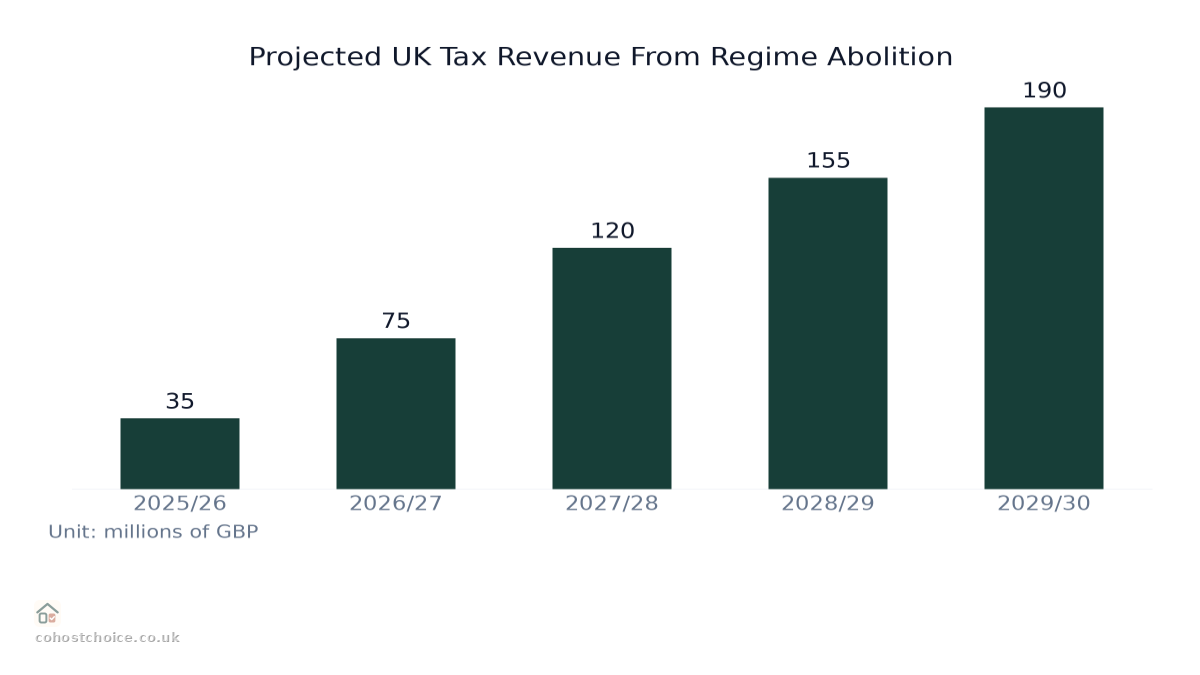
HMRC tax yield models project an intake of £35 million in 2025/26, rising to £190 million by 2029/30 as transitional reliefs expire [1]. This revenue trajectory reflects the exchequer's focus on standardizing tax receipts from previous trading positions.
Disposals of residential properties generate a standard 24% Capital Gains Tax charge instead of the preferential 10% rate previously claimed under Business Asset Disposal Relief [2]. Owners must document past qualifying occupancy days to substantiate historic relief claims during compliance inquiries.
Projected UK Tax Revenue From Regime Abolition
Step 5: Organizing Essential Transition Records
Landlords must preserve capital allowance pool values from 5 April 2025 because existing balances can still receive annual writing-down deductions. New investments in furniture and white goods no longer enter general plant pools and must rely entirely on replacement of domestic items relief [1]. Separate records for brand-new fixtures versus direct replacements protect your annual claims against routine compliance challenges.
Married couples who own properties jointly face a mandatory 50:50 income tax split unless they hold unequal beneficial interests as tenants in common [3]. Changing this default split requires executing a valid deed of trust and submitting Form 17 to HMRC within 60 days of signature . Failure to lodge documentation on time invalidates the non-standard profit distribution and results in automatic reassessments.
Evaluating Policy Impact on Revenue
The national tax changes align holiday accommodation rules with conventional long-term residential buy-to-let investments. The Treasury projects substantial revenue growth through restricted finance cost reliefs and the withdrawal of favorable capital disposals. Property owners who want to claim business rates for rentals must still satisfy local council letting criteria independently of these national income tax adjustments.
HMRC invested in updating administrative IT platforms to integrate holiday accommodation data into standard property forms [1]. This automation enables compliance teams to cross-reference portal earnings against individual tax returns. Operators who fail to report gross receipts correctly face automated inquiry notices and interest penalties on unpaid tax.
Formulating Accountant Questions and Reviewing Management
Owners must schedule a detailed planning session with a chartered tax adviser to evaluate mortgage relief reductions and lingering pool write-downs. Ask your accountant how the basic rate finance tax credit impacts your marginal bracket and whether your pension contributions require downward adjustments. Many landlords also review holiday let safety compliance documents while restructuring their operational agreements for the coming year.
Your accountant should clarify how the loss of rollover relief affects your future portfolio sales and whether holding assets within an incorporated structure offers distinct benefits. Professional management providers listed on public directories help property owners track ongoing operating costs efficiently. Independent verification of agency fees enables clearer budgeting under the restricted tax rules.
Key Actions for Property Owners
The end of the furnished holiday lettings tax regime removes former trading perks, including 100% mortgage interest deductions and preferential capital allowances. The policy is expected to generate £190 million annually by 2029/30 as owners transition to standard UK property reporting. Landlords must audit their asset registers, separate replacements from initial purchases, and calculate net yields under the 20% finance cost credit.
Speak with your accountant immediately to review joint ownership deeds, unutilized trading losses, and long-term capital gains exposure. Update your booking fee structure and compare local management solutions to keep operations profitable under the standard tax framework. Careful financial planning protects your overall wealth from unexpected tax liabilities.
Frequently Asked Questions
How does the abolition affect my mortgage interest tax relief?
You can no longer deduct mortgage interest directly from your gross rental income to calculate taxable profit. Landlords now receive a basic rate tax credit worth 20% of their finance costs against their final income tax bill.
What is the difference between capital allowances and replacement relief?
Capital allowances allowed owners to deduct the initial cost of furniture and equipment against profits. Replacement of domestic items relief only covers the cost of replacing existing furniture, excluding initial purchases.
Can married couples still split holiday let profits flexibly?
HMRC applies a default 50:50 income split to married couples who own rental property jointly. You must hold unequal beneficial shares as tenants in common and submit Form 17 within 60 days to alter this division.
Search local management companies by location, compare published fee structures side by side, and request a quote with confidence.
Compare Holiday Let Management Providers